
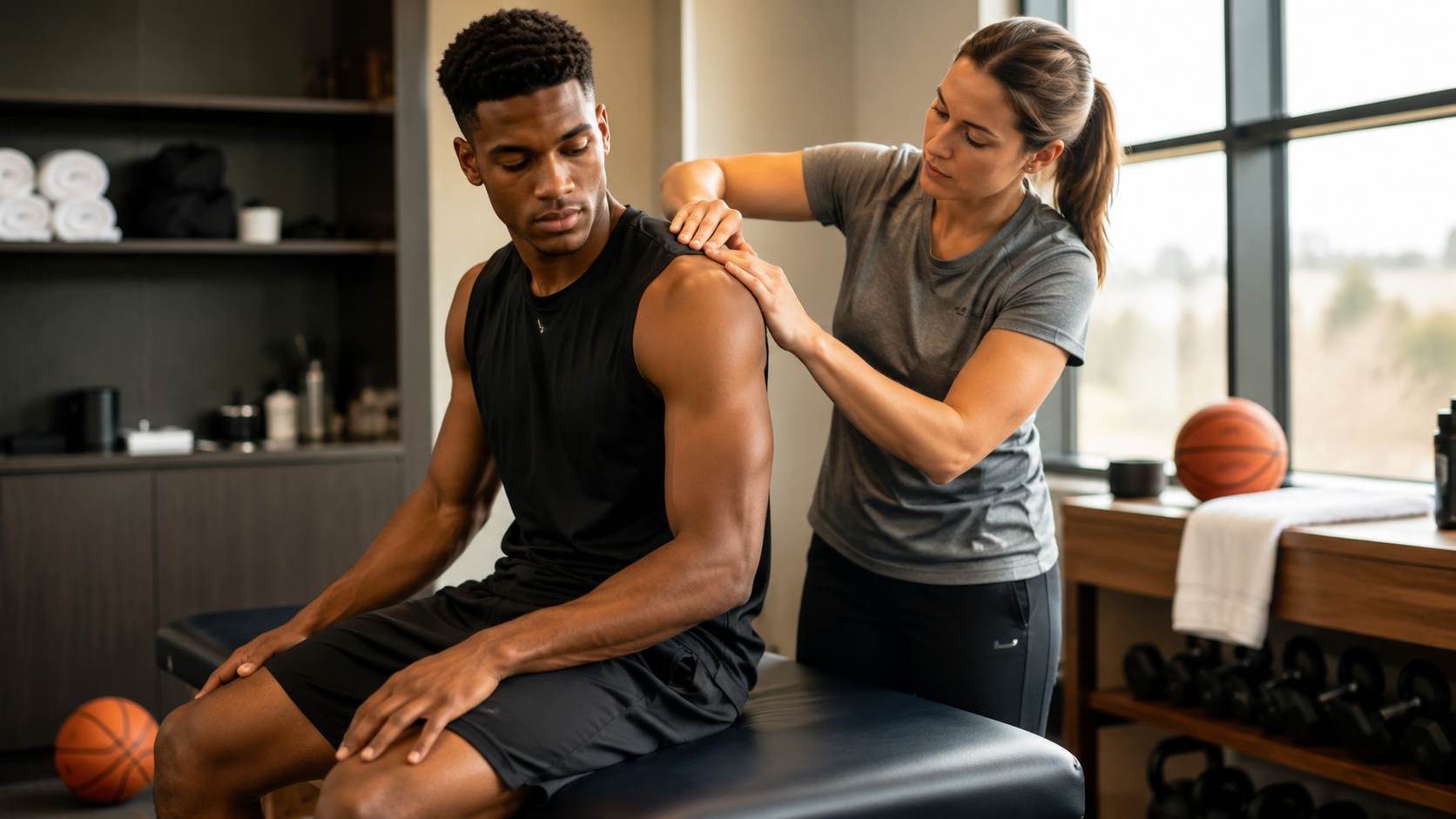
Every March, I watch college basketball with one eye on the game and one eye on the bench. After more than a decade as a licensed massage therapist, I notice things most fans miss — the way a guard rolls out a hamstring before a free throw, the wrap on a sore wrist, the trainer working a player’s shoulder during a timeout. Behind every team chasing a Final Four berth is an entire wellness infrastructure most people never see. And massage therapy is right at the center of it.
A recent feature in Massage Therapy Journal (Summer 2026) pulled back the curtain on how programs like Duke, Michigan, Michigan State, and Iowa State are using massage therapy at the highest level of college basketball. What struck me — though it didn’t surprise me — is how closely their approach mirrors the work I do every day at Active Muscle Health.
From “As Needed” to Built In
Not long ago, even at elite programs, a player got a massage when an injury flared up. That has changed. Jose Fonseca, Duke’s Associate Director of Athletic Medicine and Head Men’s Basketball Athletic Trainer, described how the program has moved from calling on massage reactively to weaving it into their broader sports medicine model from day one. At Michigan, two therapists come into the facility every week during the season to work on the entire roster. At Michigan State, the team’s therapist travels with the players, available in the hotel and after games.
The shift here matters: these programs are using massage preventively, not just reactively. They’ve decided that keeping bodies healthy is cheaper, faster, and more effective than waiting for something to break down.
I see the same pattern with my clients in Rochester. The people who get the most out of bodywork aren’t the ones who finally come in after months of waking up with a stiff neck — they’re the ones who build massage into the rhythm of their lives. Every two weeks. Once a month. Whatever the cadence, the principle is the same: small, consistent investments compound.
Communication Is the Quiet Superpower
One of the threads running through the article is how much elite programs rely on communication between the therapist and the training staff. Chris Williams at Michigan brings a sheet to every visit listing each athlete, the time they’re scheduled, and the reason for the session. Therapists check in with trainers before they start. Players are encouraged to speak up about pressure, areas of focus, and how their body is responding in the moment.
This isn’t unique to D1 athletes. It’s exactly what I ask of my clients. When you walk into my treatment room, I want to know what your body is doing this week — not just what brought you in last month. Did you sleep poorly? Did you finally take that long bike ride? Are you carrying something emotionally that’s settling into your shoulders? The more honest the intake, the more targeted the work.
Individualized Care, Always
The therapists profiled in the article draw from sports massage, manual therapy, myofascial release, scar work, and other modalities — using whatever best fits the goals of that particular session. There’s no one technique that works for every body, every time.
This is the heart of orthopedic and medical massage. I trained at the Onondaga School of Therapeutic Massage and have spent more than a decade refining my deep tissue and orthopedic work because real bodies need real specificity. The shoulder that hurts when you lift your arm overhead is different from the shoulder that aches at night. A focused 60-minute session aimed at the right structures will outperform a 90-minute session that just moves oil around.
How to Borrow from the Elite Playbook
You don’t need a scholarship to take care of your body like it matters. A few takeaways from how the best programs do it:
- Make it routine. Once a month is a floor, not a ceiling.
- Talk to your therapist. Real assessment requires real information.
- Match the work to the goal. Recovery, pain relief, mobility, and stress reduction call for different approaches.
- Treat sleep and rest as performance. Because they are.
At Active Muscle Health, I offer custom therapeutic and orthopedic sessions — and every session includes complimentary hot stones on the back, because warmth is one of the most underrated tools we have. My Reward Minutes program is designed to make consistency easier: the more you show up, the more time you earn on the table.
If you’re ready to stop treating your body like it’ll forgive you forever, book a session or send me a message with questions. The Final Four is a long way from Winton Road — but the principles are the same.
Inspired by “Going Dancing: How NCAA Basketball Teams Are Using Massage Therapy” by David Malone, Massage Therapy Journal, Summer 2026.